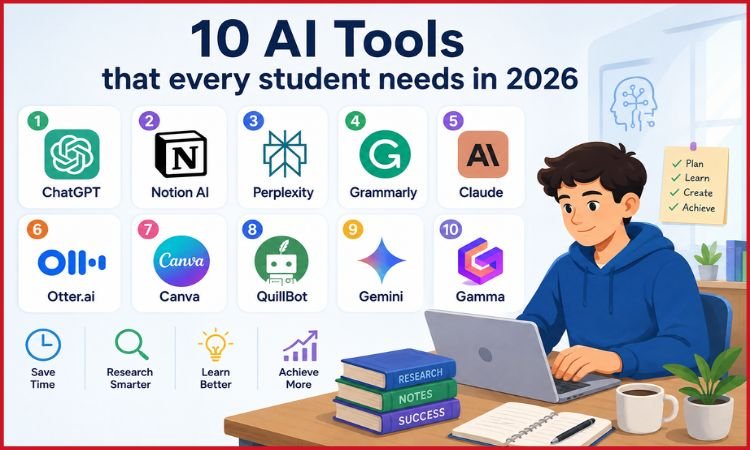
Top AI Apps Every Student Needs in 2026
Meta Description: Discover the top AI apps every student needs in 2026 — from research and writing to flashcards and note-taking. A practical, human guide to studying smarter this year.
Keywords: AI apps for students, best AI tools 2026, AI study apps, student productivity apps, AI for education
Introduction
Remember when studying meant highlighting textbooks until your hand cramped, and “research” meant hours buried in library shelves? Those days feel like ancient history now.
In 2026, students aren’t just using AI as a fun gimmick — it’s become as essential as a laptop or a notebook. From summarizing dense lecture notes in seconds to catching grammar mistakes before a professor ever sees them, AI apps have quietly become every student’s secret study partner.
But here’s the catch: with dozens of AI tools flooding the market, how do you know which ones are actually worth your time? We’ve broken down the apps that are genuinely helping students learn faster, write better, and stay organized — without turning into a crutch that replaces real thinking.
Let’s dive into the AI apps every student needs in their toolkit this year.
1. ChatGPT — The All-Rounder Study Companion
ChatGPT remains one of the most widely used AI tools among students, and for good reason. It’s flexible enough to explain complex topics in simple terms, help brainstorm essay ideas, and even walk you through tricky math problems step by step.
The key is using it the right way — as a tutor that helps you understand, not a shortcut that writes your assignments for you.
Best for: Quick explanations, brainstorming, and general-purpose help across subjects.
2. NotebookLM — Research You Can Actually Trust
One of the biggest complaints students have about AI is hallucination — when a tool confidently gives you wrong information. That’s where NotebookLM stands out. It grounds its answers directly in the documents and sources you upload, making it a favorite for research-heavy coursework.
Best for: Students who need reliable, source-based research without made-up facts.
3. Grammarly — Your Writing Safety Net
Grammarly has long been a staple for student writing, and it continues to hold its place as an essential tool in 2026. It reviews your writing in real time, catching grammar mistakes, awkward phrasing, and tone issues — helping you sound more polished no matter what you’re writing.
Best for: Essays, emails, and any assignment where clear writing matters.
4. Notion AI — Organize Your Entire Student Life
Juggling deadlines, class notes, and group projects can get overwhelming fast. Notion AI helps students build an organized workflow — from summarizing meeting notes to managing to-do lists and project timelines all in one place.
Best for: Students who want one central hub for notes, planning, and productivity.
5. Quizlet — Smarter Flashcards, Better Retention
Flashcards have always been a study classic, but Quizlet’s AI features take them to the next level with adaptive learning and personalized quiz generation based on what you actually struggle with.
Best for: Exam prep, memorization-heavy subjects, and active recall practice.
6. Perplexity — The AI-Powered Research Assistant
When you need quick, well-sourced answers without digging through pages of search results, Perplexity has become a go-to tool. It’s especially useful for students who need to fact-check information or gather research quickly.
Best for: Fast research with clear source citations.
7. QuillBot — Paraphrasing and Clarity Made Easy
QuillBot helps students rewrite and rephrase content to improve clarity, avoid repetition, and better understand complex material by seeing it explained in different ways.
Best for: Improving essay clarity and understanding dense academic text.
8. Otter.ai — Never Miss a Lecture Detail Again
For students who struggle to keep up with note-taking during fast-paced lectures, Otter.ai transcribes and summarizes spoken content in real time, making it easier to review material later.
Best for: Lecture transcription and review, especially for auditory learners.
9. Microsoft Copilot — Built Into Your Everyday Tools
For students already living inside Word, Excel, and Outlook, Microsoft Copilot integrates AI assistance directly into the tools they use daily, making it a natural fit for those in the Microsoft ecosystem.
Best for: Students who rely heavily on Microsoft Office for assignments and projects.
10. Knowt — The Free Quizlet Alternative
Knowt has carved out a strong reputation as a free, AI-powered alternative to Quizlet, automatically generating flashcards and study guides from your own notes and documents.
Best for: Budget-conscious students who still want strong flashcard automation.
How to Actually Use These Tools (Without Losing Your Edge)
Here’s the honest truth: the smartest students aren’t using AI to replace their thinking — they’re using it to sharpen it.
A good rule of thumb:
- Use research tools (like NotebookLM or Perplexity) to gather and verify information
- Use writing tools (like Grammarly or QuillBot) to refine what you’ve already drafted yourself
- Use organization tools (like Notion AI) to manage your workload
- Use memory tools (like Quizlet or Knowt) to lock in what you’ve learned
The goal isn’t to have AI do the work for you — it’s to remove the friction so you can focus your energy on actually understanding the material.
Conclusion
AI apps in 2026 aren’t just “nice to have” — they’ve become part of how students study, write, and stay organized. The trick is building a toolkit that fits your workflow instead of trying to use every app under the sun.
Pick two or three tools from this list that solve your biggest study pain points, and give yourself a real chance to build better habits with them. Used wisely, these apps won’t just save you time — they’ll help you learn better than ever before.