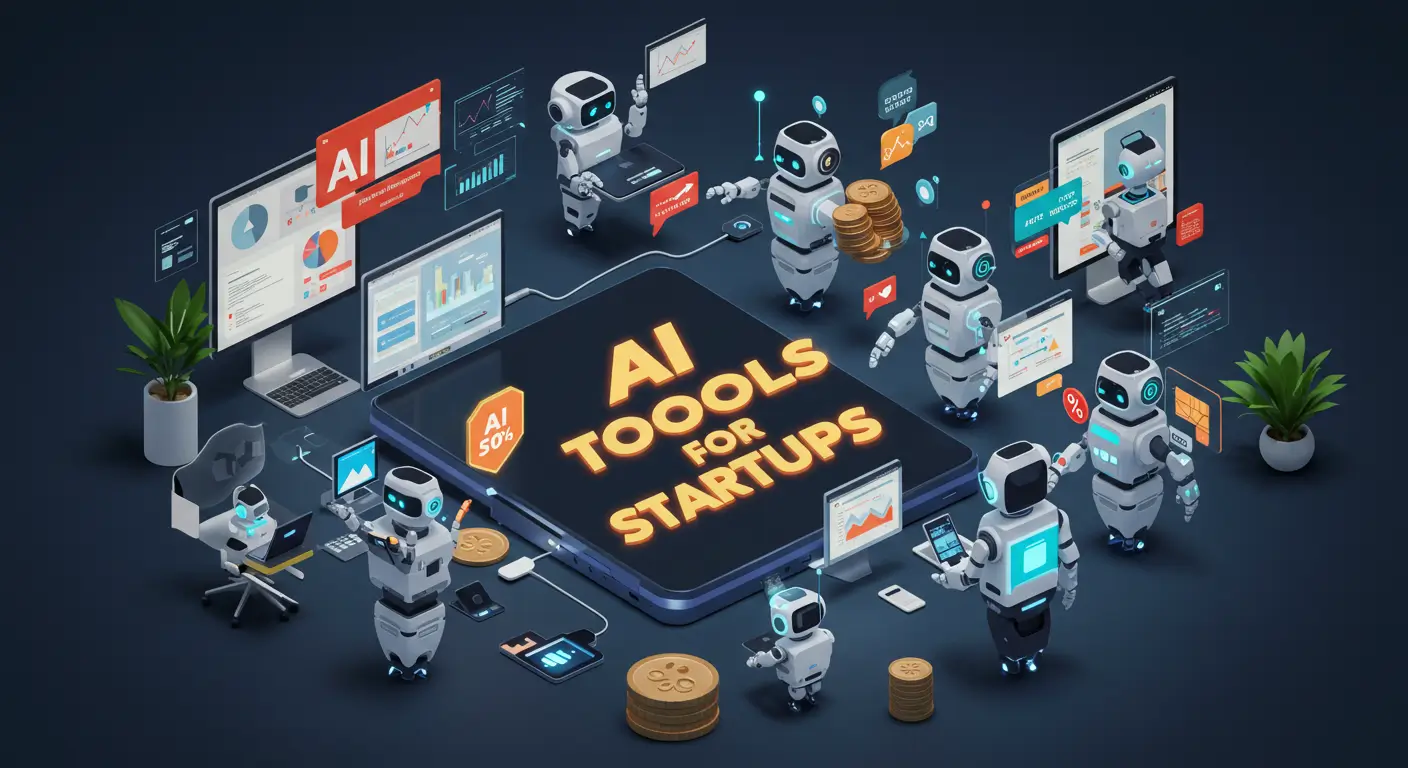
The Best AI Tools for Startups (2026 Guide to Free & Powerful Tools)
Building a business in 2026 feels a lot like being a chef in a kitchen full of magic wands. If you aren’t leveraging the best AI tools for startups, you’re basically trying to chop onions with a spoon while your competitors are using laser-guided processors.
I remember back in 2022, “startup hustle” meant sleeping under a desk and manually cold-emailing 500 people a day. Today? My “hustle” is mostly about fine-tuning the prompts that run my entire operation while I actually get to have a life. This guide is born out of that transition—from the grind to the flow—focusing on the tools that actually move the needle for founders who are tight on cash but big on vision.
Why 2026 is the Year of the “Leaner” Startup
In previous years, you needed a team of ten to launch a serious MVP. Now, thanks to the explosion of specialized AI Tools for Startups (2026 Guide to Free & Powerful Tools), a solo founder can operate with the efficiency of a mid-sized corporation. We’ve moved past the “hallucination era” of AI. The tools we have now are precise, integrated, and—most importantly—often free to start.
The New Reality: “AI-First” or “Last Place”
It is no longer about whether you use Artificial Intelligence; it is about how it is integrated into your company. A friend of mine recently launched an eco-friendly packaging brand. In two days, she used Artificial Intelligence to create her brand identity, build her website, and set up a customer service bot that handles 90% of customer queries.
She has not hired any employees yet, and her brand is already generating $15,000 per month. That is the power of using tools like Artificial Intelligence effectively.
1. The Powerhouse Generalists: Your Virtual C-Suite
Before we get into the niche stuff, every startup needs its “brain.” These are the multimodal models that act as your strategist, coder, and copywriter.
Gemini 3 Flash & GPT-5 (Free Tiers)
While the paid versions offer more “muscle,” the free tiers in 2026 are incredibly capable.
- Best for: Brainstorming pivots, drafting legal documents (that you should still show a lawyer!), and complex data analysis.
- The “Human” Hack: Don’t just ask for a business plan. Feed the AI your raw, messy notes from a coffee shop brainstorming session and ask it to “find the holes in my logic.”
Claude 4 “Haiku”
Anthropic’s lean model is the king of nuance. If you need an email that doesn’t sound like it was written by a robot, Claude is your best bet. It understands tone better than almost any other system I’ve tested this year.
2. Marketing and Content: Winning the Attention War
The hardest part of a startup isn’t building the product; it’s getting anyone to care. These AI tools make you look like you have a full marketing agency on retainer.
Brand & Design: Look Like a Unicorn on a Pony Budget
- Canva Magic Studio: In 2026, Canva’s AI is so advanced it can take a text description of your product and generate a full social media campaign—video, captions, and scheduling—in minutes.
- Midjourney v7 / Nano Banana 2: For high-end product photography. You don’t need a studio; you just need a good prompt. I’ve seen startups use AI-generated lifestyle photos that look more “real” than actual shoots.
Content Creation that Actually Ranks
- Perplexity for Research: Forget scrolling through 20 Google tabs. Perplexity gives you cited, real-time data, which is essential for writing “thought leadership” posts that aren’t just fluff.
- Descript: If you’re doing video or podcasts (and you should be), Descript is non-negotiable. You can edit video by deleting text in a transcript. It’s literal magic for founders who hate video editing.
3. Product Development: Coding Without the Degree
The barrier to entry for “non-technical” founders has officially crumbled. If you can clearly describe what you want, you can build it.
Cursor & Replit Agent
These are the gold standard for 2026. You don’t need to know Python or React inside out. You just need to be a good “architect.”
- The Experience: I recently watched a founder with zero coding background build a functional internal CRM in a single weekend using Replit. He just “chatted” the app into existence.
Bubble + AI Integration
For those building No-Code apps, Bubble’s new AI integration allows you to generate entire workflows by just saying, “When a user signs up, send a welcome email and add them to my Stripe dashboard.”
4. Operations and Sales: Automating the Boring Stuff
This is where you win back your sleep. These tools handle the “administrivia” that kills startup momentum.
The “Auto-Pilot” Sales Stack
- Clay: This is a game-changer for outbound sales. It uses AI to scrape the web, find your ideal customers, and write a personalized “why I’m reaching out” line based on their recent LinkedIn activity.
- Fireflies.ai: It joins your Zoom calls, takes perfect notes, and extracts “action items.” No more “wait, what did we agree on?” emails.
Customer Support: The 24/7 Employee
- Intercom Fin: A chatbot that actually works. It consumes your entire help center and answers customer questions with 99% accuracy. It’s the difference between a frustrated customer and a loyal one.
Maximizing the Impact of AI Tools for Startups
To truly get the most out of this this list of AI tools for startups, you have to change your mindset. Don’t look at AI as a “search engine.” Look at it as a “junior associate.”
The “Human + AI” Workflow
- Draft with Heart: Always start with your unique insight or “the spark.”
- Amplify with AI: Use the tools to expand, format, and optimize.
- Refine with Human Eyes: Never hit ‘publish’ or ‘send’ without a final human pass. Your “weirdness” is your competitive advantage; AI is just the megaphone.
Final Thoughts: The Cost of Waiting
The most expensive thing in a startup isn’t software; it’s time. What makes you different is what helps you stand out. Artificial Intelligence is simply a tool to amplify your unique voice and ideas.
The AI Tools for Startup Growth mentioned here aren’t just “cool tech.” These things are the foundation of the economy. Start using at least one tool this week—whether it’s a note-taking assistant or a no-code website builder. You will feel like a big burden is being lifted off your shoulders.
Frequently Asked Questions
Which AI tools are best for a startup with zero budget? The “Freemium” tier is your best friend. Start with Gemini for general strategy, Canva’s free tier for branding, and Replit for basic web development. These tools are powerful enough to help you get started and even earn your first $1,000 using their free versions. The free versions of these tools are powerful enough to help you earn your first $1,000 in revenue.
- Is AI-generated content bad for SEO in 2026? Only if it’s “lazy.” Google evaluates content based on Experience, Expertise, Authoritativeness, and Trust (E-E-A-T). If you use AI for writing but add your personal insights and a human tone, Google is more likely to rank your content higher. You will rank better if you add unique insights and maintain a human tone. Pure, unedited AI spam, however, will get buried.
- How do I protect my startup’s data when using AI? Always check the “Data Training” settings. Opt-out of allowing the models to train on your inputs, and never feed proprietary source code or sensitive customer PII (Personally Identifiable Information) into a public LLM.
Conclusion
Navigating the landscape of AI Tools for Startups (2026 Guide to Free & Powerful Tools) is no longer a luxury—it is a survival skill. We’ve explored how a modern founder can leverage everything from multimodal “brains” for strategy to specialized agents for coding and sales automation. The goal isn’t to replace your creativity, but to strip away the soul-crushing busywork that leads to founder burnout.
My final advice? Don’t try to adopt every tool at once. Pick one thing slowing down your business—like content creation or customer acquisition—and use one of these tools to fix it today. The most successful startups in 2026 will not be the ones with the most funding, but those that effectively combine human creativity with Artificial Intelligence. Keep learning, avoid wasting time or money, and let AI handle the heavy work while you focus on your vision.